
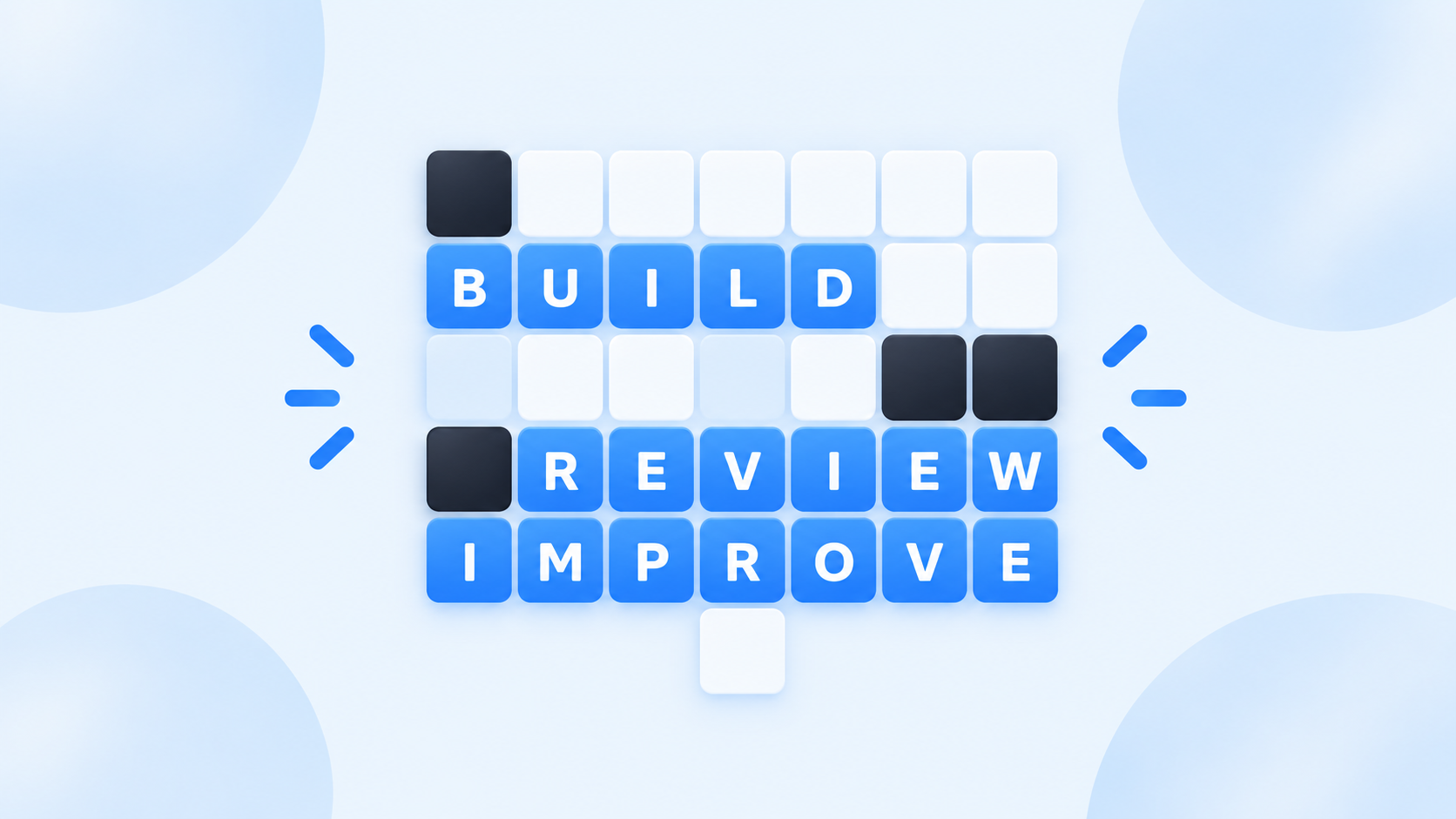
Every CrossWordy puzzle starts with the same goal: create a grid that is enjoyable to solve, gives players useful opportunities for deduction and uses words that feel fair.
Creating the puzzle is only the first step. Before puzzles become part of the CrossWordy stream, they go through a series of automated and human checks designed to catch weak words, awkward combinations and puzzles that simply do not play well enough.
Building the 6×6 grid
CrossWordy puzzles use a 6×6 grid containing a mixture of hidden three-, four-, five- and six-letter words.
The generator has to do more than fit words into the available spaces. It also needs to create a puzzle that gives the player useful routes through the grid.
A technically valid grid is not automatically a good CrossWordy puzzle.
Keeping the word pool sensible
Word quality matters enormously in a deduction game.
A puzzle can become frustrating very quickly if an answer is excessively obscure, questionable or feels unfair once revealed.
CrossWordy therefore uses reviewed word lists and exclusions to prevent unsuitable answers from entering new puzzles.
Words can also be removed later if player feedback or further review shows that they do not work well in practice.
Avoiding too much repetition
Variety is another important part of the puzzle stream.
Longer answer words are controlled particularly carefully so players are not repeatedly encountering the same distinctive solutions.
Shorter words naturally have fewer alternatives, so some reuse is unavoidable, but the generator still tries to maintain variety across the stream.
The aim is for each new puzzle to feel like a fresh challenge rather than a rearrangement of something the player has just seen.
Checking for very similar puzzles
Two grids can technically be different while still feeling almost identical to play.
CrossWordy therefore checks for exact and near-duplicate puzzles as part of the generation process.
This helps prevent repeated word combinations and overly similar grids from appearing too close together.
Matching puzzles to difficulty
Not every valid puzzle belongs at the same difficulty level.
Some grids provide obvious early discoveries and develop quickly. Others require more experimentation before the pattern becomes clear.
CrossWordy groups puzzles by difficulty so the stream can provide a sensible progression rather than presenting every puzzle as though it offers the same challenge.
Difficulty is not determined solely by a formula. Real player results are also useful because they show how a puzzle actually performs once people start solving it.
Reviewing puzzles after they are played
Puzzle review does not stop when a puzzle is published.
CrossWordy can collect anonymous gameplay information such as whether puzzles are solved, how many guesses are used and whether players choose to leave feedback.
Gameplay tracking is disabled by default. Players can choose to allow anonymous usage tracking, and doing so helps us understand how puzzles perform in practice and where the game can be improved.
Players can also rate puzzles and comment on individual words or difficulty.
These signals help highlight puzzles that deserve another look.
Player feedback matters
Automated data can identify unusual results, but it cannot always explain them.
A player saying that a particular answer felt obscure, that a puzzle was unexpectedly difficult or that something simply did not feel right can be extremely useful.
Feedback is treated as a review signal rather than automatic proof that something is wrong. The puzzle and the words involved can then be considered in context.
Removing weaker puzzles
There is no requirement for every generated puzzle to survive forever.
If a puzzle contains a weak answer, feels too similar to another puzzle or consistently performs poorly, it can be retired from the stream.
We would rather have fewer good puzzles than keep a puzzle simply because it has already been generated.
UK and US English
CrossWordy supports both UK and US English spelling preferences.
Where spelling differs, players can be served puzzles appropriate to their chosen version of English. This avoids situations where a perfectly familiar word appears wrong simply because it uses the spelling convention from another country.
You can read more about this in Why CrossWordy supports UK and US English.
Puzzle quality is an ongoing process
CrossWordy is designed around a continuously reviewed puzzle stream rather than a fixed library that is never revisited.
Generation rules improve, word lists evolve and player feedback provides new information about how puzzles behave in the real world.
That means the puzzle stream can keep improving along with the game itself.
Ready to try one?
Want to improve your solving too? Read our How to get better at CrossWordy guide.